Main Menu

Explore More

Cognitive Learning

COGNITIVE TRAINING INTEGRATED INTO THE ACADEMIC ACHIEVEMENT CLASS

Training the skills behind learning.

Our Cognitive Training program strengthens the thinking skills students rely on throughout the day. Servite High School is the first school in Orange County to integrate this type of cognitive training directly into the academic school day through its Academic Achievement Class. The program is led by Mrs. Barnard, Director of Support Services.

THE PROGRAM

Built directly into the school day.

20 Minutes Daily

Students participate in a 20-minute daily training regimen integrated into their Academic Achievement Class.

The program incorporates games developed at Northeastern University.
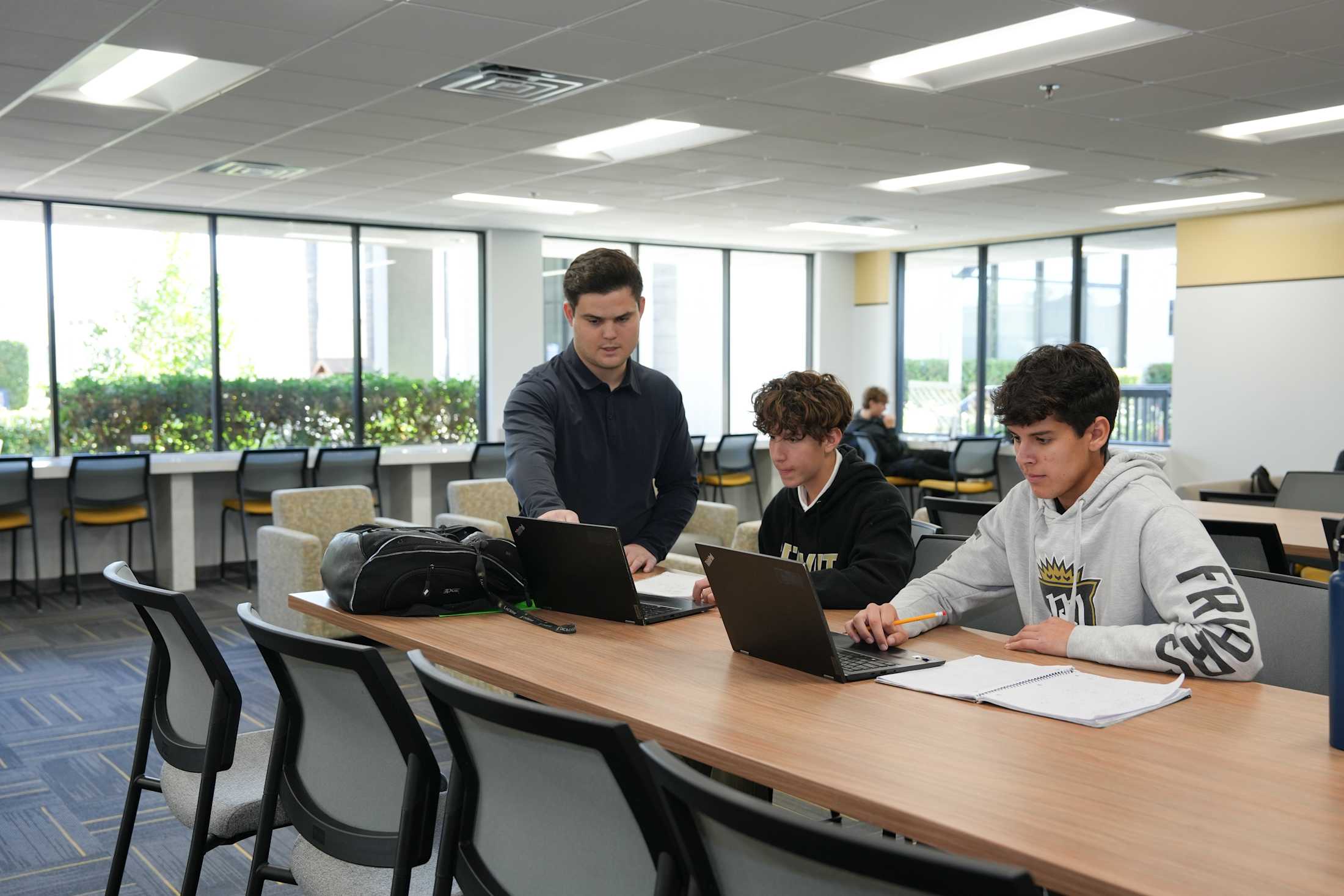
Servite students in support services setting
Servite students working together
Servite student academic support moment
COGNITIVE PROCESSING & ACADEMICS

How cognitive skills support academic performance.

Working Memory
Processing Speed
Cognitive Flexibility
Reading
Decoding, fluency, connecting new information to prior knowledge, retaining new material, and comprehension.
Decoding, fluency, and reading rate.
Fluency, comprehension, making inferences, and incorporating new information into background knowledge.
Writing
Organizing and storing new ideas, sentence structure, spelling, and switching between different phases of the writing process.
Generating ideas in a timely manner, planning the writing assignment, quality and quantity of written work, and the ability to express ideas coherently.
Generating ideas, finding and using words to describe something, organizing thoughts, and adding details.
Math
Retrieving math facts, performing multi-step calculations, understanding word problems, manipulating numbers, and applying operations.
Impacts the speed at which one understands and solves math problems, fluency, and retrieval of math facts.
Ability to switch between strategies to solve problems or solve math problems in different ways, look at a math problem from different perspectives, and switch operations.
RESEARCH
STUDY LED BY

Dr. Eugene Wong

Cal State San Bernardino

Dr. Eugene Wong has been leading a study examining the impact of cognitive training on Prentice students' working memory, processing speed, and cognitive flexibility.

Improvements in all three areas have been observed.
WHY COGNITIVE TRAINING MATTERS

Strengthening the skills that support learning.

EXECUTIVE FUNCTION

Executive-function skills such as working memory can have a significant impact on academic performance.

Supporting learning differences +

For students with learning differences, challenges in these areas can affect their ability to process information, retain learning, move between tasks or ideas, and demonstrate what they know.

Helping bridge gaps +

By incorporating cognitive training into the school day, we are providing targeted opportunities to strengthen these foundational skills and help bridge gaps that can interfere with learning.

Looking beyond diagnoses +

Learning differences are not limited to students with formal diagnoses. Every student has an individual learning profile, and understanding those differences can help schools provide more effective instruction and support.

Cognitive training and learning

Cognitive abilities become more connected.

Working memory, processing speed, and cognitive flexibility do not operate alone. As training continues, additional connections develop among the abilities students use to learn, solve problems, and adjust their approach.

Baseline

Starting connections

Cognitive connections at baseline Working memory, processing speed, and cognitive flexibility are connected by one line between each pair. WORKING MEMORY COGNITIVE FLEXIBILITY PROCESSING SPEED

One connection per relationship

After 6 Hours

Connections developing

Cognitive connections after six hours Working memory, processing speed, and cognitive flexibility are connected by two lines between each pair. WORKING MEMORY COGNITIVE FLEXIBILITY PROCESSING SPEED

Two connections per relationship

After 12 Hours

More integrated network

Cognitive connections after twelve hours Working memory, processing speed, and cognitive flexibility are connected by three lines between each pair. WORKING MEMORY COGNITIVE FLEXIBILITY PROCESSING SPEED

Three connections per relationship

In this conceptual diagram, more gold lines represent more connections among working memory, processing speed, and cognitive flexibility.


MEET OUR TEAM

Lisa Barnard

Director of Support Services

Gyzah Garcia

Student Support Coordinator

Will Matuzak '17

Support Services Teacher